SISTEM USAHA TANI JAGUNG PADA GAWANG KELAPA
DOI:
https://doi.org/10.25077/js.2.1.1-9.2005Abstract
A research about integrated farming system research for maize among coconut trees was carried out in Tabek Panjang village, Lima Puluh Kota Regency. The objective of the research was to find out the best adaptation of maize variety, hybrid and high yielding of maize composite, combined with zero tillage technology. The data were analyzed by using comparative analysis approach between the improve technology in the technical work (productivity and economic cost, profitable and R/C ratio). The result showed that maize C9 hybrid gave the highest yield 7,34 ton/ha, maize C7 hybrid and Bisma varieties gave yields 6,84 ton/ha and 4,56 ton/ha, respectively. The farm operation analysis showed that maize C9 hybrid gave profit Rp 4,060,000 and R/C 2,24 , maize C7 hybrid Rp 3,561.000 and R/C 2,09 and maize Bisma variety Rp. 1,434,850 R/C ratio 1,46. In general, the result of the a study showed that land preparation with zero tillage system was better for maize C7 and C9 hybrids planted among coconut trees. Keywords: The intercropping farming system, zero tillageReferences
Bappeda Sumbar. 2000. Sumatera Barat dalam Angka. Kerja sama Bappeda Tk 1 Sumatera Barat dengan Kantor Statistik Tk 1 Sumatera Barat.
Darwis, S.N.1988. Tanaman Sela diantara Kelapa. Pusat Penelitian dan Pengembangan Tanaman Industri . 129 hal
Foth, H.D. 1988. dasar dasar Ilmu Tanah. Diterjemahkan oleh: Ir. Endang Dwi Purbayanti, MS; Ir. Dwi Retno Lukiwati, MS; Ir. Rahayuning Tri Mulatsih. Editor Ir. Sri Andani B. Hudoyo, MS. Fakultas Peternakan Universitas Diponegoro. Gajah Mada University Press. 782 hal
Hardjo Wigeno, S. 1987. Ilmu Tanah. Medyatama. Sarana Perkasa. Jakarta. 220 hal
Joseph, G.H ;A.Mangkey dan J.Tabrani.1999. Perbaikan Sitem Usaha Tani Padi Gogo dan Jagung diantara Tanaman Kelapa. Proseding Seminar Nasional. Hasil Penelitian dan Pengkajian Teknologi Pertanian Menghadapi Era Otonomi Daerah. Palu 3-4 November 1999.
Kinsella,J. 1998. Pengaruh Beberapa Sistem Pengolahan Tanah pada Kompaksi tanah. Farming for a Better Enviroment. Diterjemahkan oleh bidang imformasi Diseminasi Forum Komunikasi olah tanah konservasi. Himpunan ilmu Gulma Indonesia. Mosanto. PT. Monagro Kimia.
Kasim. F, M. Dahlan dan Subandi. 1995. Sistem produksi benih jagung hibrida. Makalah disajikan oleh Kepala Puslitbangtan pada Diskusi dengan BAPENAS, Desember 1995.
. Puslitbangtan. 2002. Inovasi teknologi jagung. Menjawab tantangan ketahana pangan nasional. Puslitangtan. Bogor.
Ruthenberg,H. 1980. Farming System in Tropics,Third Edition. Clarendon Press. Oxford 424 P.
Rinsema, W.T.1986. Pupuk dan Cara Pemupukan. Bhratara Karya Aksara. Jakarta 235 hal
Sarief, S. 1986. Kesuburan dan Pemupukan Tanah Pertanian. Pustaka Buana. Bandung 182 hal
Subandi,I.G.Ismail dan Hermanto.1998. Jagung. Teknologi Produksi dan Pascapanen. Puslitbangtan Bogor.
Tan, K.H. 1991. Dasar dasar Kimia Tanah. Penerjemah: Ir. Didiek Hadjar Goenadi, MSc. Phd. Balai Penelitian Perkebunan Bogor. Penyunting: Ir. Bostang Radja gukguk, MSc. Phd. Fakultas Pertanian Universitas Gajah Mada. Gajah Mada university press. 295 hal
Tim Peneliti Badan Litbang Pertanian.1998.Laporan hasil penelitian optimalisasi pemamfaatan sumber alam dan teknologi untuk pengembangan sektor pertanian dalam pelita V11.Pusat Penelitian Tanah danAgroklimat Bogor.386 hl
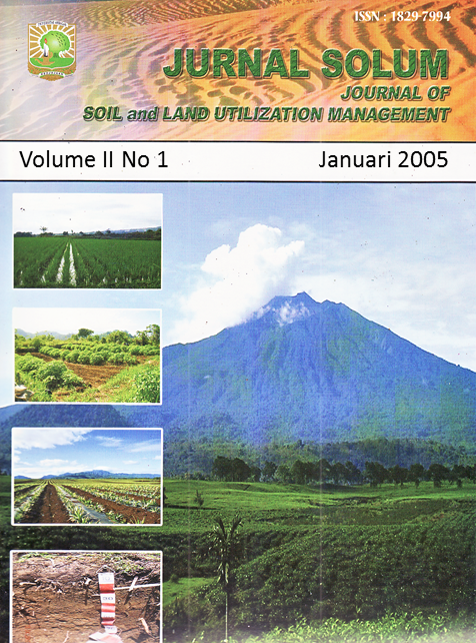
Downloads
Published
Issue
Section
License
Please find the rights and licenses in Jurnal Solum. By submitting the article/manuscript of the article, the author(s) accept this policy.
1. License
The non-commercial use of the article will be governed by the Creative Commons Attribution license as currently displayed on Creative Commons Attribution-NonCommercial-ShareAlike 4.0 International License.
2. Author(s) Warranties
The author warrants that the article is original, written by stated author(s), has not been published before, contains no unlawful statements, does not infringe the rights of others, is subject to copyright that is vested exclusively in the author and free of any third party rights, and that any necessary written permissions to quote from other sources have been obtained by the author(s).
3. User Rights
Jurnal Solum spirit is to disseminate articles published are as free as possible. Under the Creative Commons license, Jurnal Solum permits users to copy, distribute, display, and perform the work for non-commercial purposes only. Users will also need to attribute authors and Jurnal Solum on distributing works in the journal.
4. Rights of Authors
Authors retain the following rights:
- Copyright, and other proprietary rights relating to the article, such as patent rights,
- the right to use the substance of the article in future own works, including lectures and books,
- the right to reproduce the article for own purposes, provided the copies are not offered for sale,
- the right to self-archive the article.
5. Co-Authorship
If the article was jointly prepared by other authors, any authors submitting the manuscript warrants that he/she has been authorized by all co-authors to be agreed on this copyright and license notice (agreement) on their behalf, and agrees to inform his/her co-authors of the terms of this policy. Jurnal Solum will not be held liable for anything that may arise due to the author(s) internal dispute. Jurnal Solum will only communicate with the corresponding author.
6. Royalties
This agreement entitles the author to no royalties or other fees. To such extent as legally permissible, the author waives his or her right to collect royalties relative to the article in respect of any use of the article by Jurnal Solum.
7. Miscellaneous
Jurnal Solum will publish the article (or have it published) in the journal if the article(s_ editorial process is successfully completed. Jurnal Solum editors may modify the article to a style of punctuation, spelling, capitalization, referencing and usage that deems appropriate. The author acknowledges that the article may be published so that it will be publicly accessible and such access will be free of charge for the readers as mentioned in point 3.